
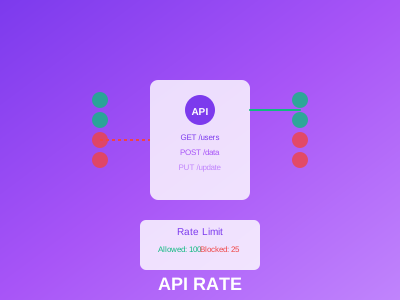
Modern web applications and distributed APIs operate under continuous traffic volatility. Whether handling spikes from marketing campaigns, crawler aggregators, automated integrations, or malicious denial-of-service attempts, an API without protective traffic shaping is an existential liability.
Rate limiting and throttling are foundational architectural safeguards. While rate limiting governs how many requests a client can transmit within a discrete temporal threshold, throttling actively regulates processing velocity to preserve service stability, protect downstream databases, and enforce multi-tenant fairness.
In this deep dive, we evaluate the core mathematical models of rate limiting, analyze real-world distributed bottlenecks, and implement an atomic Token Bucket engine in Redis.
The Core Rate Limiting Algorithms
Every rate limiting strategy represents a distinct tradeoff between computational complexity, memory footprint, and burst tolerance.
+---------------------------+-------------------+--------------------+------------------------+
| Algorithm                 | Memory Footprint  | Burst Handling     | Boundary Precision     |
+---------------------------+-------------------+--------------------+------------------------+
| Fixed Window Counter      | O(1) per client   | Vulnerable to 2x   | Poor at window borders |
| Sliding Window Log        | O(N) requests     | Exact & Smooth     | Perfect precision      |
| Sliding Window Counter    | O(1) per client   | Smooth averaging   | Approximation (~99%)   |
| Token Bucket              | O(1) per client   | Allows burst to C  | Exact token replenishment|
| Leaky Bucket              | O(N) queue depth  | Smooth output rate | Rejects on queue full  |
+---------------------------+-------------------+--------------------+------------------------+
1. Fixed Window Counter
The fixed window counter divides time into discrete, immutable intervals (e.g., 60 seconds). A counter increments with each request. When the counter exceeds the threshold $L$, subsequent requests within that window are rejected.
The Boundary Vulnerability: If a client sends its full quota of 100 requests at second 59, and another 100 requests at second 61, the server processes 200 requests across a 2-second interval—effectively doubling the intended capacity limit and overwhelming downstream workers.
2. Sliding Window Log
To resolve boundary spikes, the sliding window log stores a UNIX timestamp for every incoming request inside a sorted set. When a new request arrives:
- All timestamps older than
currentTime - windowSizeare evicted. - The remaining element count is evaluated against the quota.
- If allowed, the current timestamp is appended.
While mathematically exact, storing individual timestamps for high-throughput APIs introduces significant memory consumption: $100{,}000\text{ req/sec} \times 8\text{ bytes} \times 60\text{s} \approx 48\text{ MB}$ of transient memory overhead per client.
3. Token Bucket
The Token Bucket algorithm remains the industry standard for distributed API gateways (powering systems like AWS API Gateway, Cloudflare, and Envoy).
A bucket has a maximum capacity $C$ and is replenished with tokens at a sustained fill rate $R$ (tokens per second). Each incoming request consumes one token:
- If tokens are available: the request is processed, and the token count decrements.
- If the bucket is exhausted: the request is throttled with HTTP
429 Too Many Requests.
This design naturally permits controlled bursts up to $C$ while guaranteeing that steady-state consumption never exceeds $R$.
Production Implementation: Atomic Token Bucket in Redis
In a distributed infrastructure with multiple stateless application nodes, evaluating token buckets locally in server memory results in fragmented, inaccurate quotas. Centralizing the state in Redis solves this, but naive read-modify-write sequences introduce race conditions.
To achieve atomic evaluation, we encapsulate the replenishment and consumption logic in an atomic Redis Lua script:
-- KEYS[1]: Rate limit bucket key (e.g., "ratelimit:user_1024")
-- ARGV[1]: Bucket capacity (maximum burst limit)
-- ARGV[2]: Refill rate per second
-- ARGV[3]: Current timestamp (Unix seconds with millisecond float)
-- ARGV[4]: Requested tokens (typically 1)

local key = KEYS[1]
local capacity = tonumber(ARGV[1])
local refill_rate = tonumber(ARGV[2])
local now = tonumber(ARGV[3])
local requested = tonumber(ARGV[4])

-- Retrieve current bucket state
local data = redis.call("HMGET", key, "tokens", "last_updated")
local tokens = tonumber(data[1])
local last_updated = tonumber(data[2])

if tokens == nil then
    -- Initialize new bucket at full capacity
    tokens = capacity
    last_updated = now
else
    -- Calculate replenished tokens based on elapsed duration
    local elapsed = math.max(0, now - last_updated)
    tokens = math.min(capacity, tokens + (elapsed * refill_rate))
    last_updated = now
end

-- Evaluate token availability
if tokens >= requested then
    tokens = tokens - requested
    redis.call("HMSET", key, "tokens", tokens, "last_updated", last_updated)
    -- Expire bucket key after idle duration to reclaim memory
    local ttl = math.ceil(capacity / refill_rate) * 2
    redis.call("EXPIRE", key, ttl)
    return {1, math.floor(tokens)} -- Allowed: [status=1, remaining_tokens]
else
    redis.call("HMSET", key, "tokens", tokens, "last_updated", last_updated)
    return {0, math.floor(tokens)} -- Throttled: [status=0, remaining_tokens]
end
TypeScript Middleware Integration
import { createClient } from 'redis';

const redis = createClient({ url: process.env.REDIS_URL });

export interface RateLimitResult {
  allowed: boolean;
  remainingTokens: number;
  retryAfterSeconds?: number;
}

export async function checkRateLimit(
  clientId: string,
  capacity: number = 60,
  refillRate: number = 1.0 // 1 token/sec = 60 req/min sustained
): Promise<RateLimitResult> {
  const key = `ratelimit:${clientId}`;
  const now = Date.now() / 1000;

  // Execute preloaded Lua script sha
  const [allowed, remaining] = (await redis.evalSha(LUA_SCRIPT_SHA, {
    keys: [key],
    arguments: [
      capacity.toString(),
      refillRate.toString(),
      now.toString(),
      '1'
    ],
  })) as [number, number];

  if (allowed === 1) {
    return { allowed: true, remainingTokens: remaining };
  }

  // Calculate backoff delay until 1 token is replenished
  const retryAfter = Math.ceil((1 - remaining) / refillRate);
  return {
    allowed: false,
    remainingTokens: 0,
    retryAfterSeconds: Math.max(1, retryAfter),
  };
}
Standardized HTTP Response Headers
Communicating rate limit telemetry clearly to client applications prevents aggressive polling loops and facilitates graceful client-side backoff.
Adhere to the IETF RateLimit Header Field specifications:
HTTP/1.1 429 Too Many Requests
Content-Type: application/json
Retry-After: 12
RateLimit-Limit: 60
RateLimit-Remaining: 0
RateLimit-Reset: 12

{
  "error": "rate_limit_exceeded",
  "message": "Quota limit reached. Please throttle requests.",
  "retry_after_seconds": 12
}RateLimit-Limit: Quota ceiling for the active policy window.RateLimit-Remaining: Available tokens remaining for immediate consumption.RateLimit-Reset: Window reset delta (in seconds) or Unix epoch reset point.Retry-After: Standardized HTTP backoff indicator indicating when the next request may be retried.
Distributed Edge Considerations: Multi-Region Deployments
In multi-region cloud environments spanning US, EU, and APAC clusters, querying a centralized Redis cluster across trans-oceanic fibers introduces 80ms–150ms of network latency per API request.
To avoid this bottleneck:
- Local In-Memory Cache with Asynchronous Replenishment: Edge workers (e.g., Cloudflare Workers or Envoy sidecars) consume from local in-memory token pools and batch synchronization to regional Redis caches.
- Deterministic Partitioning: Route user-specific requests deterministically to specific geographical regions via Anycast or Consistent Hash routing so each client’s bucket state resides in a single datastore.
- Graceful Degradation: If the distributed cache experiences connectivity partitions, fallback to coarse-grained in-memory node-level limits rather than failing open or dropping valid traffic.