The debate between Representational State Transfer (REST) and GraphQL has evolved beyond dogma into a nuanced engineering evaluation. Rather than viewing GraphQL as an unconditional replacement for REST, modern engineering organizations assess both paradigms according to workload characteristics, caching requirements, client diversity, and operational complexity.
In this architectural guide, we dissect the concrete tradeoffs between resource-oriented REST and graph-oriented query documents, examine the N+1 problem, evaluate HTTP edge caching, and establish an objective decision matrix for production teams.
Architectural Paradigms: Resource vs. Graph
At their core, REST and GraphQL approach distributed data access from opposing philosophies.
REST (Resource-Oriented):
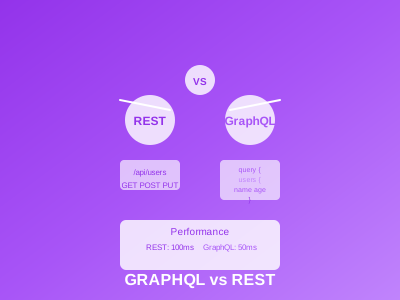
GET /api/v1/users/42          ──► [User Data]
GET /api/v1/users/42/orders   ──► [Orders List]
GET /api/v1/products/808      ──► [Product Details]
(Multiple round trips or bloated composite endpoints)

GRAPHQL (Graph-Oriented):
POST /graphql
{
  user(id: "42") {
    name
    orders { id total product { title price } }
  }
}                             ──► [Exact tailored payload in 1 round trip]
The REST Model
REST models system state as discrete resources identified by uniform URIs. Clients manipulate these resources using standard HTTP verbs (GET, POST, PUT, PATCH, DELETE).
- Strengths: Native alignment with the HTTP protocol, ubiquitous tooling, deterministic URLs, and trivial integration with web caching infrastructure.
- Weaknesses: Susceptible to over-fetching (retrieving unneeded fields in large representations) and under-fetching (requiring multiple waterfall requests to assemble aggregate views).
The GraphQL Model
GraphQL introduces a strongly typed query language and runtime engine. Clients issue a single document specifying precisely the fields and nested associations required.
- Strengths: Complete elimination of over-fetching, atomic data retrieval across multiple relational boundaries in a single network round-trip, and an explicit schema contract.
- Weaknesses: Loss of native HTTP caching, vulnerability to expensive unbounded queries, query complexity management, and the infamous N+1 execution problem.
The Caching Battleground: HTTP Edge vs. Normalized Client Cache
Caching efficiency frequently dictates API scalability under high read concurrency.
+--------------------------+---------------------------------+---------------------------------+
| Capability               | REST (HTTP-Native)              | GraphQL                         |
+--------------------------+---------------------------------+---------------------------------+
| Edge CDN Caching         | Native (RFC 9111 Cache-Control) | Difficult (POST requests)       |
| Invalidation             | Fine-grained per URI/ETag       | Complex graph invalidation      |
| Client-Side Caching      | Browser HTTP cache              | Normalized store (Relay/Apollo) |
| Bandwidth Utilization    | Moderate (fixed schemas)        | Optimal (sparse field sets)     |
+--------------------------+---------------------------------+---------------------------------+
REST: Free Edge Caching via CDNs
Because REST operations use distinct HTTP GET endpoints, edge proxy caches (Cloudflare, Fastly, AWS CloudFront) cache responses effortlessly:
HTTP/1.1 200 OK
Cache-Control: public, max-age=3600, stale-while-revalidate=60
ETag: W/"33a64df551425fcc55e4d42a148795d9f25f89d4"
Content-Type: application/json
A cache hit at a CDN point-of-presence (PoP) resolves in single-digit milliseconds without consuming backend compute or database IOPS.
GraphQL: The POST Challenge & Normalized Stores
Because GraphQL queries are historically submitted via HTTP POST to a single endpoint (/graphql), standard HTTP intermediary caches cannot evaluate response freshness based on URL path alone.
While solutions like Automatic Persisted Queries (APQ) permit GET-based caching for pre-registered query hashes, updating or invalidating individual entities within composite graph responses remains non-trivial. Clients must maintain complex normalized memory caches (such as Apollo Client or Urql) that index entities by __typename:id.
Solving the N+1 Problem with DataLoader
In naive GraphQL server implementations, nested field resolvers trigger cascaded database queries. If a client queries 50 users and their recent orders, a naive resolver executes 1 query for users, followed by 50 individual queries for orders—a severe performance hazard known as the N+1 problem.
The canonical architectural solution is batching and memoization via the DataLoader pattern:
import DataLoader from 'dataloader';
import { db } from './database';

interface Order {
  id: string;
  userId: string;
  total: number;
}

// Instantiate DataLoader per incoming request to prevent cross-request leakage
export function createOrderLoader() {
  return new DataLoader<string, Order[]>(async (userIds: readonly string[]) => {
    // Single batched SQL query: SELECT * FROM orders WHERE user_id IN (...)
    const orders = await db.query(
      `SELECT * FROM orders WHERE user_id = ANY($1)`,
      [userIds]
    );

    // Group retrieved orders by userId to preserve DataLoader input array order
    const orderMap = new Map<string, Order[]>();
    for (const userId of userIds) {
      orderMap.set(userId, []);
    }
    for (const order of orders) {
      orderMap.get(order.userId)?.push(order);
    }

    return userIds.map((id) => orderMap.get(id) || []);
  });
}
By coalescing multiple discrete resolver invocations within a single tick of the Node.js event loop into a single SQL IN query, DataLoader flattens $O(N)$ database hits into an efficient $O(1)$ batch.
Production Decision Matrix
Use this engineering criteria to determine the appropriate paradigm:
Choose REST when:
- Public APIs & Third-Party Developers: REST remains the universal standard for developer platforms where external consumers lack GraphQL client libraries.
- Heavy Read-Heavy Workloads with High Cache Hit Ratios: Media catalogs, news portals, and public product listings benefit enormously from edge CDN caching.
- Binary File Handling: Uploading and streaming multi-gigabyte media streams, PDFs, or raw binary assets integrates naturally with standard multipart and streaming HTTP endpoints.
- Minimal Schema Complexity: Small microservices with 5–10 flat endpoints gain little from GraphQL’s overhead.
Choose GraphQL when:
- Diverse Multi-Platform Clients: Applications serving disparate frontends (smartphones, smart watches, web apps) with radically different screen real estate and bandwidth constraints.
- Highly Relational Dashboard UIs: Screens aggregating data across multiple microservices or relational models where assembling composite views in REST requires waterfall requests.
- Rapid Frontend Feature Iteration: Frontend engineers can reshape UI views and request additional fields without requesting backend endpoint modifications.
- Strong Schema Contracts with Code Generation: End-to-end type safety using GraphQL Code Generator creates synchronized TypeScript types directly from the backend schema.