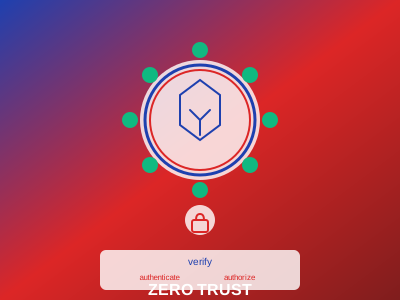
The traditional perimeter-based security model—colloquially known as the “castle-and-moat” paradigm—assumed that all actors, services, and network traffic within an internal VPC or corporate network were inherently trustworthy. In modern cloud-native architectures, distributed microservices, and Single Page Applications (SPAs), this assumption is demonstrably invalid.
Compromised developer credentials, supply-chain package poisoning, insider threats, and lateral network traversal necessitate an uncompromising security philosophy: Never trust, always verify.
In this architecture guide, we outline how to apply Zero Trust principles directly to modern web application frontends and API backends, establishing cryptographic verification at every boundary.
The Four Pillars of Zero Trust Web Architecture
A production Zero Trust posture operates across four synchronized planes:
+-----------------------------------------------------------------------------------------+
|                                1. VERIFIED IDENTITY                                     |
| Continuous, context-aware authentication with ephemeral, short-lived cryptographic tokens |
+-----------------------------------------------------------------------------------------+
                                           │
                                           ▼
+-----------------------------------------------------------------------------------------+
|                             2. MICROSEGMENTED ACCESS                                    |
| Scoped Role-Based & Attribute-Based Access Control (RBAC/ABAC) evaluated at every API hop |
+-----------------------------------------------------------------------------------------+
                                           │
                                           ▼
+-----------------------------------------------------------------------------------------+
|                            3. BROWSER SANDBOX HARNESS                                   |
| Strict Content Security Policy (CSP Level 3), Subresource Integrity (SRI), iframe sandboxing|
+-----------------------------------------------------------------------------------------+
                                           │
                                           ▼
+-----------------------------------------------------------------------------------------+
|                           4. CONTINUOUS TELEMETRY AUDIT                                 |
| Structured security event ingestion and anomaly detection without capturing sensitive PII|
+-----------------------------------------------------------------------------------------+
1. Identity & Cryptographic Token Verification
In a Zero Trust architecture, an authentication handshake is not a one-time event that grants indefinite authorization. Every incoming API request must prove both the validity of its claims and that the client presenting the token is its legitimate holder.
To combat token exfiltration via Cross-Site Scripting (XSS), modern standards leverage Demonstrating Proof-of-Possession (DPoP) (RFC 9449). DPoP cryptographically binds access tokens to an asymmetric key pair held in the client’s browser subtle crypto storage:
import { jwtVerify, createRemoteJWKSet } from 'jose';

// Cached JSON Web Key Set (JWKS) endpoint
const JWKS = createRemoteJWKSet(
  new URL('https://auth.ladestack.in/.well-known/jwks.json')
);

export interface VerifiedSecurityContext {
  userId: string;
  tenantId: string;
  scopes: Set<string>;
}

export async function verifyZeroTrustToken(
  authHeader: string | null,
  requiredScope: string
): Promise<VerifiedSecurityContext> {
  if (!authHeader || !authHeader.startsWith('Bearer ')) {
    throw new Error('Missing or malformed Authorization header');
  }

  const token = authHeader.substring(7);

  // Cryptographically verify signature, issuer, audience, and temporal validity
  const { payload } = await jwtVerify(token, JWKS, {
    issuer: 'https://auth.ladestack.in',
    audience: 'https://api.ladestack.in',
    clockTolerance: '5s',
  });

  const scopes = new Set(((payload.scope as string) || '').split(' '));

  if (!scopes.has(requiredScope)) {
    throw new Error(`Insufficient privileges: missing scope '${requiredScope}'`);
  }

  return {
    userId: payload.sub as string,
    tenantId: payload.tid as string,
    scopes,
  };
}
2. Hardening the Browser Execution Context
A secure backend is rendered defenseless if the frontend executing in the user’s browser is vulnerable to script injection or unauthorized exfiltration.
Content Security Policy Level 3 (CSP)
Configure strict, nonce-based Content Security Policy headers on all HTML responses to prevent inline script execution and restrict network egress:
Content-Security-Policy:
  default-src 'none';
  script-src 'self' 'nonce-rAnd0m12345' 'strict-dynamic';
  style-src 'self' 'unsafe-inline';
  img-src 'self' data: https://ladestack.in;
  font-src 'self';
  connect-src 'self' https://api.ladestack.in;
  frame-ancestors 'none';
  base-uri 'none';
  form-action 'self';
Sandboxing Untrusted Computations in iframes
When running third-party plugins, user-supplied scripts, or untrusted execution engines (as implemented in tools like GB Coder), run compute inside isolated subframes with the HTML sandbox attribute:
<iframe
  src="/sandbox/runner.html"
  sandbox="allow-scripts"
  csp="default-src 'none'; script-src 'self' 'unsafe-eval';"
  referrerpolicy="no-referrer"
  loading="lazy"
  title="Isolated Code Execution Sandbox"
></iframe>
By intentionally omitting allow-same-origin, the execution sandbox is treated as a unique, null-origin document, permanently preventing it from reading the host window’s localStorage, cookies, or DOM.
3. Mutual TLS (mTLS) for Inter-Service Communication
Within your backend infrastructure, do not rely on network IP allowlists or VPN boundaries. Every service-to-service communication channel should require Mutual TLS (mTLS) where both the client microservice and the receiving service present cryptographically signed X.509 certificates issued by a private internal Certificate Authority (CA).
This guarantees:
- Mutual Authentication: Neither endpoint can be spoofed by a compromised adjacent container on the same Kubernetes node.
- In-Transit Wire Encryption: Zero plain-text communication across internal switches or cloud provider virtual networks.
- Automatic Identity Rotation: Short-lived certificates rotated every 24 hours minimize the blast radius of key leakage.