Modern browser-based code editors face an inherent technical dilemma: developers demand the rich language intelligence, auto-completion, and diagnostic feedback of a desktop IDE like Visual Studio Code, yet expect instant live preview execution without stalling the main UI thread.
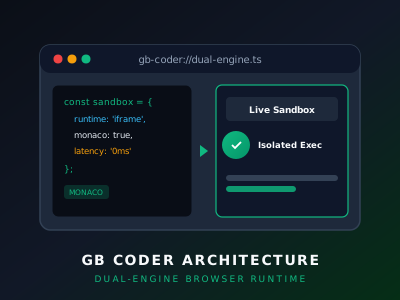
In constructing GB Coder—LadeStack’s flagship web-based development environment—we rejected heavyweight cloud-tethered container models in favor of a client-centric Dual-Engine Architecture. This article details how GB Coder orchestrates Monaco Editor, isolated iframe sandboxes, and structured message channels to achieve sub-millisecond execution loops directly within the client browser.
The Architectural Challenge of In-Browser IDEs
Traditional browser IDEs generally fall into one of two extremes:
- Remote Cloud Virtual Machines: Every file edit is transmitted via WebSockets to a containerized server (e.g., Docker or Firecracker microVM). While this enables full POSIX compatibility, it introduces network latency, substantial recurring server infrastructure costs, and offline fragility.
- Naive In-Thread Evaluation: Simple playground tools evaluate user code directly in the top-level browsing context using
eval()or unconstrained DOM injection. A singlewhile(true)infinite loop freezes the user interface, destroys unsaved state, and introduces serious Cross-Site Scripting (XSS) risks.
GB Coder circumvents both constraints by separating Language Intelligence (The Static Engine) from Runtime Execution (The Dynamic Sandbox).
┌────────────────────────────────────────────────────────┐
│                   MAIN BROWSER CONTEXT                 │
│                                                        │
│  ┌─────────────────────────┐  postMessage (RPC)        │
│  │   Monaco Editor Core    │ ──────────────────────┐   │
│  │ (AST / Syntax / Linter) │                       │   │
│  └─────────────────────────┘                       │   │
└────────────────────────────────────────────────────┼───┘
                                                     │
                                                     ▼
┌────────────────────────────────────────────────────────┐
│               SANDBOXED IFRAME CONTEXT                 │
│               sandbox="allow-scripts"                  │
│                                                        │
│  ┌─────────────────────────┐  Blob Object URL          │
│  │  Virtual DOM & Console  │ ◄──────────────────────   │
│  │ (Clean Window Instance) │                           │
│  └─────────────────────────┘                           │
└────────────────────────────────────────────────────────┘
Engine 1: Monaco Editor Integration & AST Services
The editor surface is built upon Microsoft’s Monaco Editor engine, running inside dedicated Web Workers. This ensures that heavy syntax parsing, bracket matching, and TypeScript Abstract Syntax Tree (AST) validation never compete with the main rendering thread.
Web Worker Thread Isolation
Monaco’s language services are spawned using standard Web Workers:
// Initializing Monaco language worker pool
import * as monaco from 'monaco-editor';

self.MonacoEnvironment = {
  getWorkerUrl: function (_moduleId: string, label: string): string {
    if (label === 'typescript' || label === 'javascript') {
      return '/workers/ts.worker.bundle.js';
    }
    if (label === 'html' || label === 'handlebars') {
      return '/workers/html.worker.bundle.js';
    }
    if (label === 'css' || label === 'scss' || label === 'less') {
      return '/workers/css.worker.bundle.js';
    }
    return '/workers/editor.worker.bundle.js';
  }
};
By decoupling language compilation into background threads, GB Coder maintains a fluid 60 frames-per-second typing experience even across multi-thousand-line single-page files.
Engine 2: The Sandboxed Execution Context
To render live preview output without risking the security and stability of the main application, GB Coder generates an isolated HTML document dynamically constructed inside an <iframe> container.
Restrictive Sandbox Permissions
The preview frame is restricted using HTML5 iframe security attributes:
<iframe
  id="gb-preview-frame"
  sandbox="allow-scripts allow-modals"
  csp="default-src 'self' 'unsafe-inline' blob: data:; img-src * data: blob:;"
  src="about:blank"
  title="GB Coder Live Execution Preview"
  aria-label="Live Execution Sandbox"
></iframe>
Notice the deliberate omission of allow-same-origin. Without allow-same-origin, the execution frame treats its origin as a unique, opaque security origin (null). Even if malicious code executes within the iframe, it cannot read:
- Local storage tokens from
ladestack.in - Cookies or session data
- Surrounding DOM elements belonging to the IDE navigation
Bidirectional RPC Communication: The Console Hook
To display runtime console logs inside the GB Coder IDE dock, the sandbox intercepts native console methods and serializes arguments across the window boundary:
// Injected Sandbox Bootstrap Script
(function installConsoleProxy() {
  const originalLog = console.log;
  const originalError = console.error;

  function serialize(data) {
    try {
      return JSON.parse(JSON.stringify(data));
    } catch (e) {
      return String(data);
    }
  }

  console.log = function (...args) {
    window.parent.postMessage({
      type: 'GB_CODER_CONSOLE_EVENT',
      level: 'log',
      payload: args.map(serialize),
      timestamp: Date.now()
    }, '*');
    originalLog.apply(console, args);
  };

  console.error = function (...args) {
    window.parent.postMessage({
      type: 'GB_CODER_CONSOLE_EVENT',
      level: 'error',
      payload: args.map(serialize),
      timestamp: Date.now()
    }, '*');
    originalError.apply(console, args);
  };
})();
The host application validates message origin and structure before appending entries to the visual debug terminal:
window.addEventListener('message', (event: MessageEvent) => {
  // Validate that the event originated from our preview iframe element
  const previewFrame = document.getElementById('gb-preview-frame') as HTMLIFrameElement;
  if (!previewFrame || event.source !== previewFrame.contentWindow) {
    return;
  }

  const { type, level, payload } = event.data ?? {};
  if (type === 'GB_CODER_CONSOLE_EVENT') {
    appendTerminalMessage(level, payload);
  }
});
Architectural Comparison Matrix
| Architectural Property | Traditional Cloud IDE (Docker) | Naive In-Browser Eval | GB Coder Dual-Engine |
|---|---|---|---|
| Execution Latency | 300ms – 1200ms (network) | < 1ms (unsafe) | < 2ms (local memory) |
| Offline Execution | ❌ Requires internet | ⚠️ Fragile | ✅ Core Editor & Sandbox Run Offline |
| Crash Protection | ✅ Host protected | ❌ Entire browser tab freezes | ✅ Host protected by iframe |
| Code Payload Privacy | ⚠️ Code sent to cloud VM | ✅ Local only | ✅ Local Client Compute (No server payload transit) |
| Server Cost Per User | $5 – $25 / month | $0 | $0 (Client Compute) |
State Persistence with IndexedDB
To protect user work against accidental tab closures or system restarts, GB Coder avoids volatile memory buffers. Projects are serialized to IndexedDB upon every debounced change event (300ms debounce), with automatic schema versioning.
import { openDB } from 'idb';

const DB_NAME = 'gb_coder_workspace';
const STORE_NAME = 'project_files';

export async function persistActiveBuffer(filename: string, content: string): Promise<void> {
  const db = await openDB(DB_NAME, 1, {
    upgrade(database) {
      if (!database.objectStoreNames.contains(STORE_NAME)) {
        database.createObjectStore(STORE_NAME, { keyPath: 'filename' });
      }
    }
  });

  await db.put(STORE_NAME, {
    filename,
    content,
    updatedAt: Date.now()
  });
}
Conclusion & Next Steps
The Dual-Engine Architecture demonstrates that web applications no longer require heavy server fleets to provide professional developer tooling. By delegating syntax intelligence to Monaco Web Workers and isolating runtime evaluation inside non-same-origin sandboxed iframes, GB Coder delivers high responsiveness, strict privacy, and zero infrastructure overhead.
To experience the dual-engine architecture in action, explore GB Coder on LadeStack or launch the live IDE at code.ladestack.in. For further engineering deep-dives, consult our Developer Documentation.